
There's something most people don't know when choosing a diamond: the stone they're holding between their fingers was born billions of years ago, thousands of kilometres from where it was cut, in a river in Angola, on a beach in Namibia, or deep underground in the Central African Republic.
And that origin changes everything. Not after the cut. Before.
Gondwana, the ancestor of all continents
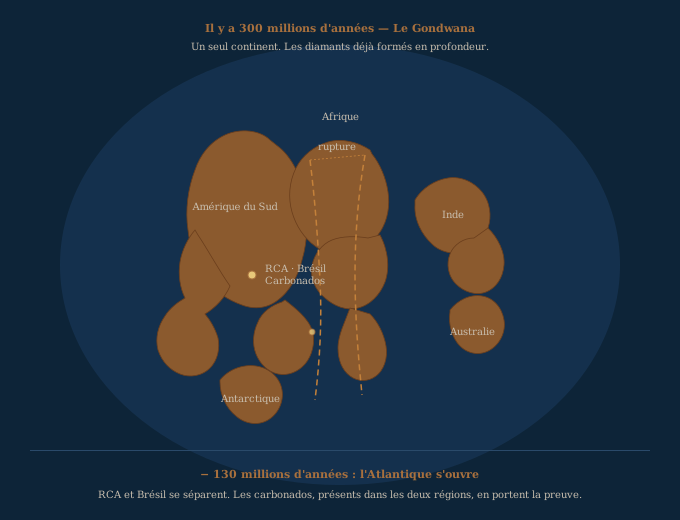
About 300 million years ago, there was only one great continent on Earth. Geologists call it Gondwana. Africa, South America, India, Australia, Antarctica, all fused into a single landmass.
Then the tectonic plates began to drift apart, slowly, over tens of millions of years. The Atlantic opened up. Africa drifted north. Brazil pulled away from central Africa.
What was once a single landmass became continents separated by oceans.
But the diamonds were already there.
How a diamond forms, and how it travels
A diamond forms between 150 and 800 kilometres below the Earth's surface, under pressures and temperatures the human mind struggles to imagine. It takes between 1 billion and 3.5 billion years to crystallise, long before complex life appeared on Earth.
It rises to the surface through volcanic conduits called kimberlite pipes, colossal underground explosions that propel diamonds upward. The kimberlite that carries them is far younger than the diamonds themselves, only a few tens to hundreds of millions of years old.
But the journey doesn't end there.
Once at the surface, exposed to erosion for millions of years, diamonds are torn from their kimberlite pipes by rain, rivers, glaciers. They travel. Sometimes thousands of kilometres, tumbling along riverbeds, wearing against pebbles, naturally sorting themselves by weight and durability.
Only the best crystals, free of inclusions, free of flaws, survive this intense journey. That's precisely why certain regions of the world produce diamonds of exceptional quality, not because the kimberlite there was better, but because the journey selected everything.
In Namibia, for example, the Orange River has carried diamonds for millions of years from kimberlite pipes deep in South Africa and Lesotho toward the Atlantic. After a journey of over 1,000 kilometres, polished by sand and currents, 95% of Namibian production is gem quality, compared to 25 to 35% for an ordinary kimberlite pipe. The journey selected everything.
The invisible link between Africa and Brazil
There's an extraordinarily rare type of diamond called carbonado, black, porous, polycrystalline, its structure radically different from classic diamonds. It's found in only two places in the world: the Central African Republic and Brazil.
Two countries separated by the Atlantic. But which, 130 million years ago, formed the same land.
This isn't a coincidence. It's direct proof that these two regions shared the same geology before Gondwana broke apart. The same underground conditions, the same minerals, the same pressures. Push the tectonic plates back together on a map, wind the clock back 130 million years, and these two regions touch.
The Bangui anomaly, the largest magnetic anomaly ever recorded on Earth's surface, located in the Central African Republic, is attributed to a colossal meteorite buried several kilometres deep, which may have contributed to unique geological conditions for the formation of these diamonds.
What this means for you
When you choose a diamond, you're also choosing, without knowing it, a geological history billions of years old. An origin. A journey.
The Angolan diamond born in the highlands, carried north by rivers into the DRC. The Namibian diamond polished for millions of years by the Atlantic before washing up on a Sperrgebiet beach. The Sierra Leonean diamond of exceptional whiteness and purity, a smooth octahedral crystal with an incomparable white-green luminosity.
These are the origins I know. The ground I've walked.
In the articles that follow, I'll take you through each country, each region, each mine. So you understand where your diamond comes from, before it ever reaches your hands.
Laurent de Toledo is a third-generation independent diamond dealer, HRD Certified Diamond Grader, trained at the Harry Oppenheimer Diamond Training School in Johannesburg. Nearly 30 years in diamonds, including 20 years buying rough in Angola and the DRC.