
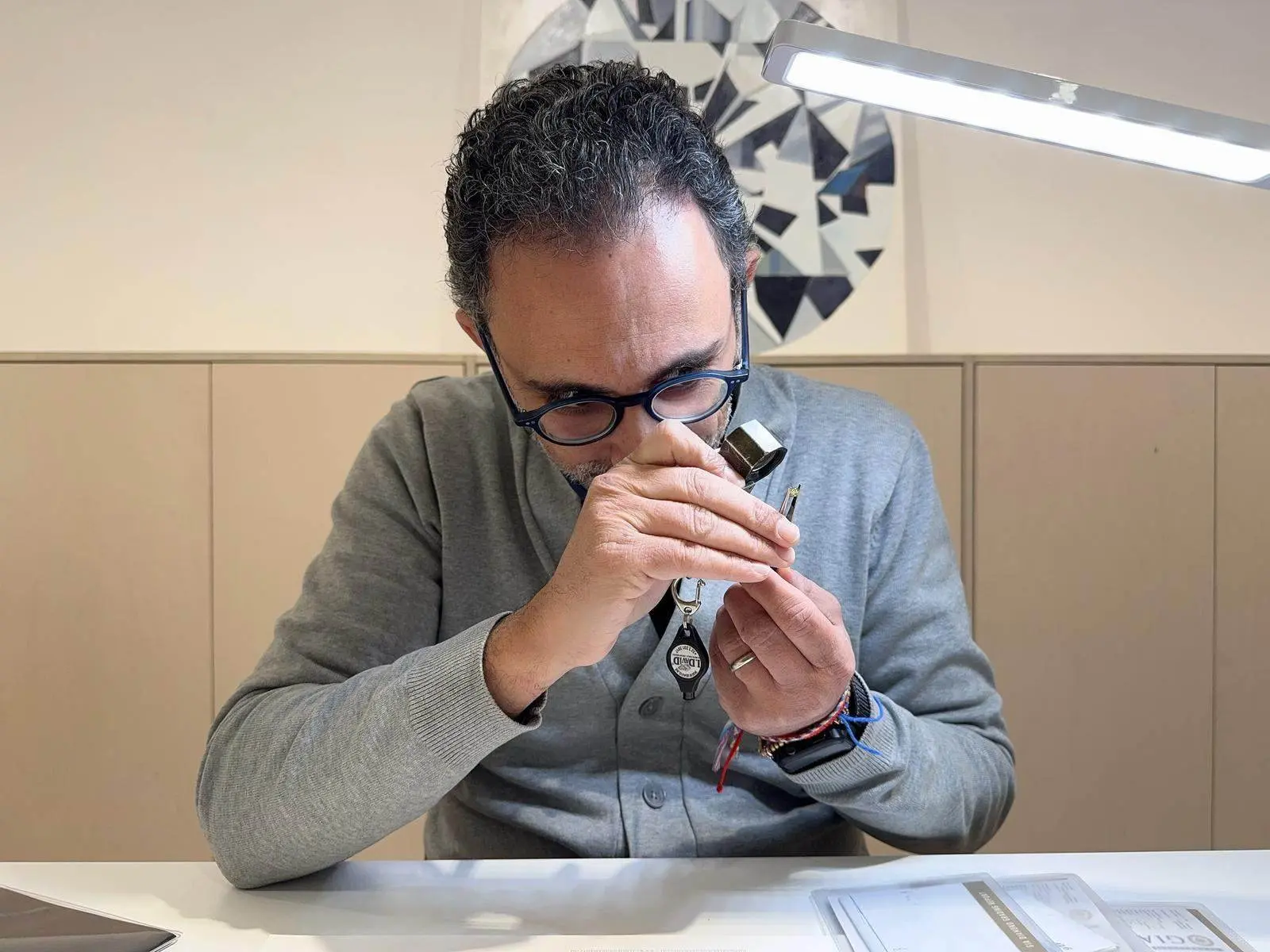
Before I even take a stone out, I look at its GIA report, or its certificate. It tells me how the inclusions are distributed, and which ones are present. But I never trust the diagram itself: the lines and red dots marking inclusions on paper don't always reflect reality. The truth is what you see under the 10x loupe, the one I use to examine every diamond.
The briefke
Once I've checked the certificate, I take the stone out of its fold, what we call, among diamond dealers, a briefke. The word comes from Dutch and simply means "little envelope", or "little letter". It's a term passed down among us for generations, inherited from Antwerp, the historic capital of the trade.
I place the stone on my pad, a white block, after picking it up with my tweezers. Then I clean it with a cloth specifically made for diamonds.
First, 30 centimetres
I observe the stone for a moment at a distance of about 30 centimetres. That's the first impression, the one any eye would get, without a loupe, without expertise. In a way, it's also the future client's own view.
Only then do I bring the stone close to my eye. I look for black inclusions, and above all their position: are they central? Off to the side? Hidden in the crown, or near the girdle? Do they cross straight through the stone?
That's the exact moment the eye becomes a lynx's eye.
The only criterion that really matters: eye clean
A stone can look heavily included on paper and still be the most interesting one, as long as it's eye clean: invisible to the naked eye, from a minimum distance of about 30 centimetres. If it doesn't pass that test, it doesn't pass my evaluation. Whatever the certificate says.
When I assess a diamond's clarity, I try to put myself in the future client's shoes. I wouldn't want a heavily included stone either, or badly placed inclusions. And I don't just look at price: sometimes, for an extra 100, 200 or 300 euros, you find a far more beautiful stone, genuinely eye clean.
Laurent de Toledo is a third-generation independent diamond dealer, HRD Certified Diamond Grader, trained at the Harry Oppenheimer Diamond Training School in Johannesburg. Nearly 30 years of experience selecting and buying diamonds, including 20 years in Africa.